Thursday, August 21, 2025
Balimaya Project and Discos Pacífico All Stars: Rhythms Merge
By Erin Cobby
Erin Cobby finds out about a new diaspora-bridging partnership between Balimaya Project and Discos Pacífico All Stars
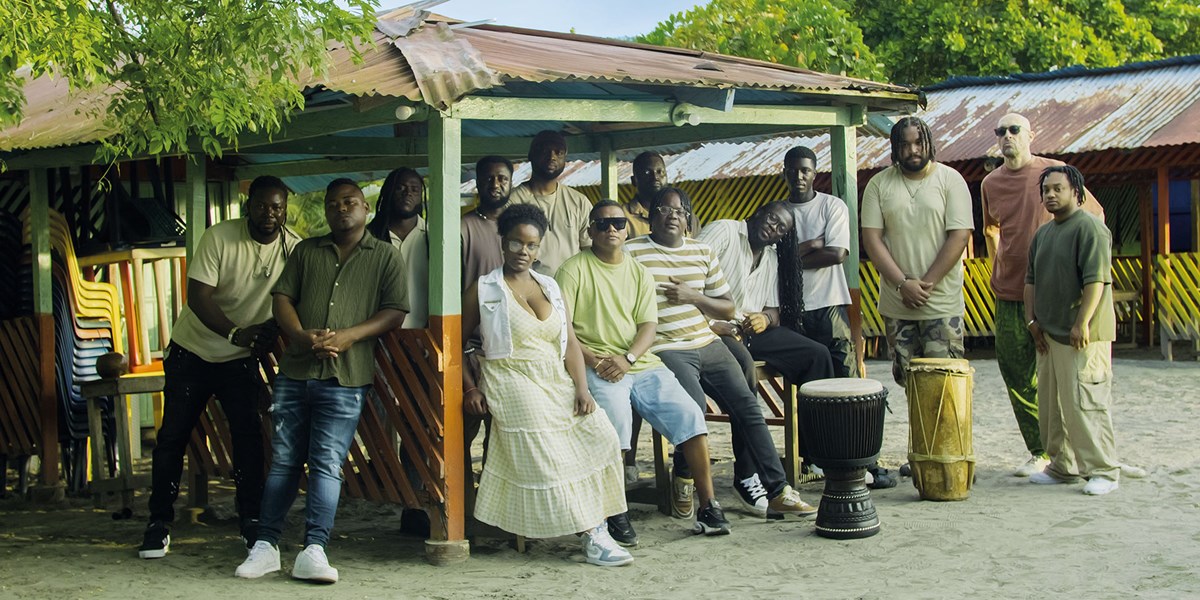
Balimaya Project x Discos Pacífico All Stars with Cankita (seventh from left) and Yahael Camara Onono (fifth from right)

‘Calima’ is a natural phenomenon when sand from the Sahara Desert travels across the Atlantic Ocean, bringing nutrients that help fertilise the tropical rainforests of Latin America and the Caribbean. It offered the perfect name for a cross-cultural album between Mandé jazz collective Balimaya Project and a group of trailblazing Afro-Colombian musicians. Just as the movement of Saharan sand bridges continents, this musical collaboration connects the shared histories of West Africa and Colombia – a symbiotic relationship that enriches both cultures.
While West Africa and Colombia are at the heart of the record, Calima has its roots in the UK. London-based Balimaya Project have two albums to their name, 2021’s Wolo So and 2023’s When The Dust Settles. For this latest project, their bandleader and lead percussionist, Yahael Camara Onono, teamed up with Colombian Luiz González Salazar (who would go on to co-executively produce the project, and also come up with the album title, Calima) to win a British Council grant dedicated to cross-cultural projects. With support from London-based Jazz re:freshed and Colombian label Llorona Records, Onono and Salazar scouted for Afro-Colombian players, recruiting members of marimba-focused groups like Bejuco, Semblanzas del Río Guapi, and former members of Agrupación Changó. These musicians have now come together under the moniker of Discos Pacífico All Stars (owing to the fact that they have all released music on Discos Pacífico, an imprint of Llorona Records).
Now, they just needed to find a way to make music together. Tumaco, on Colombia’s Pacific Coast, was chosen as the place to meet, write and record. Yet the record was initially marred with misfortune: the airline lost all the drums, meaning the largely percussive-focused group had to rethink their approach to maximise the little time they had together. Yahael explains the group embraced the hurdle and used it to their advantage: “It allowed us to look at the melodies and break them down with a new space.”
By the time the drums had arrived, ideas for songs had already taken shape, with the group overcoming their language barrier through jamming, as musical director and marimba maestro Juan Carlos ‘Cankita’ Mindinero recalls: “The music spoke. We created strong songs in a timeframe that might have allowed for less, but the quality of the musicians surpassed everything.” This was a vital starting point, adds Yahael: “It allowed us to see which instruments had similar voices, which instruments crossed over, and which instruments needed their own space.”
This interplay between instruments was crucial to the project, especially because the London and Colombian contingents both played instruments from the same families, but with different roles and dynamics. According to Yahael, congas, dunun and djembé have evolved differently across continents, growing beyond their traditional roots to become mainstays in contemporary global music. Because of this, they have developed a louder presence on stage than other percussion instruments, such as the Colombian cununo drums and guasá shakers, which needed to be taken into consideration. Likewise, they had to find a balance between the West African balafon and the Colombian marimba. “The balafon is meant to lead,” explains Yahael. “In this project, we used the [related] Bobo balan, and that has a very characteristic buzz, which is purely pentatonic in scale. So, we wanted to highlight that, while also letting the dramatic marimba step in.” He continues: “It’s all about finding balance, so everything has its space to breathe. So, as much as they’re similar, you also need to hone in on their distinctive differences so you can give those instruments their due respect.”
The six-track record was created in just two weeks, an impressive task given the musical complexity of the songs and meticulous post-production polish. Yahael laughs when reflecting on their against-all-odds achievement: “You know the saying ‘pressure creates diamonds’?”
Some tracks came to life through pure improvisation, while others were written independently and then fleshed out by the two groups. ‘Yo Te Ví’ is an example of the latter; the original idea was written by Cankita with lyrics by fellow Colombian Edwin Jimenez – who provides all the lyrics on the album, and also sings and plays percussion – about how love transforms the quotidian into something poetically beautiful. Musically, the song mirrors the feeling of blooming love: it starts simply, with polyrhythmic riffs from the marimba, before melodic overlays of Pacific vocals and Congolese rumba guitar build to an explosive finish, Yahael and his group adding to the arrangement with elements like a bridge inspired by an agbadza West African rhythm.
Yahael feels that the track ‘A Life Worth Living’ is particularly emblematic to the collaboration. Its Spanish lyrics celebrate the beauty in everyday things, and the possibility of breaking through barriers, a repeated refrain translating as ‘And with every step / I break down the walls’. Working with the Afro-Colombian contingent pushed Balimaya Project to break down their own walls, experimenting with voice in ways they hadn’t done before. “Having people that relied on their voices as an integral way to share their music was so inspiring,” says Yahael. “Balimaya is much more instrumental and relies on the horns to do that, so it forced us to look at the voice differently and added another layer and texture.”
While there were many learnings for the two acts, the most significant realisation was the strong, inherent connection between the two communities. “Africa and its diaspora are a lot more in tune with each other than we think,” says Yahael, referring to the socio-economic challenges and gruelling hardship Black communities have faced. “The resilience of the African diasporic people is something which needs to be celebrated.”
This attitude is echoed by Cankita: “We want people to hear the voices that resist from the Colombian Pacific along with all the African diaspora, with arrangements full of harmony and strong rhythms, from the bombo to the djembé.”
+ Calima is released by Jazz re:freshed / Discos Pacífico on September 5. Balimaya Project x Discos Pacífico All Stars will perform the album at London’s Barbican on September 27