Thursday, May 15, 2025
Champeta: “Reuse [of music] was not considered an infringement, but a legitimate creative practice”
Andrés Gualdrón delves into how African records, piracy and resistance shaped a Caribbean-Colombian sound
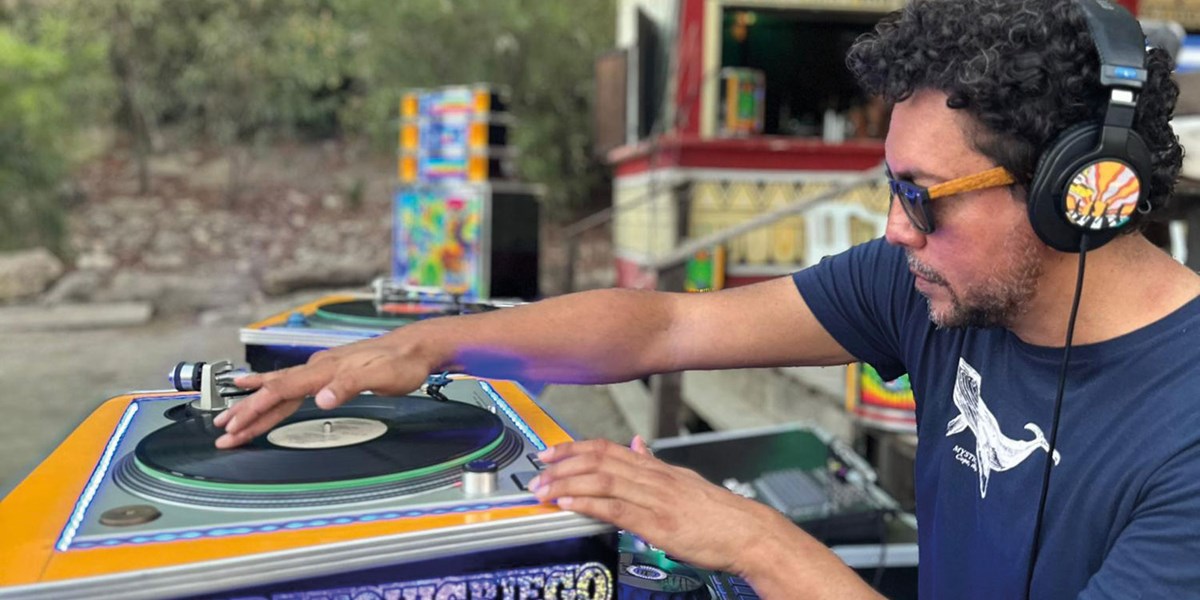
Barranquilla DJ and researcher Carlos Mojica aka Don Alirio

Entering the working-class neighbourhoods of cities like Barranquilla and Cartagena in Colombia holds a surprise. Unlike in other regions of the country – or even in wealthier sectors of these same cities – it’s common to hear African music echoing through the streets, courtyards and open-air parties, music that was composed and recorded thousands of miles away by artists in the Congo, Kenya, Cameroon and South Africa. Most are sung in languages unfamiliar to these predominantly Spanish-speaking communities. Yet this African catalogue, danced to relentlessly for nearly five decades, has become a ‘classic’ repertoire in the Colombian Caribbean, revered by legions of followers, dancers, collectors and local music scholars who continue to trace its transatlantic roots.
How did this phenomenon emerge in a country where African music never aired on commercial radio or television, or appeared in record stores? How did genres like soukous, Afrobeat, makossa and mbaqanga achieve such local fame? While its exact origins are elusive, Barranquilla researcher Carlos Mojica (alias Don Alirio) notes that by the late 1960s, the global success of Miriam Makeba’s ‘Pata Pata’ had already sparked regional curiosity about African sounds. Around the same time, owners of picós – community sound systems blasting non-mainstream music at high volumes – began sourcing obscure Caribbean records, fuelling neighbourhood demand for exclusive tracks from distant shores.
Independent importers like Osman Torregroza and Donaldo García, in the 1970s, and then David Borrás and Humberto Castillo, in the 1980s, soon circled the globe hunting African vinyl to meet this demand. French-Caribbean songs, mistaken for African due to their style and language, slipped into the mix. The records’ popularity – and the exorbitant prices they commanded – funded further expeditions. In the pre-streaming era, these traders scavenged vinyl in Guadeloupe, Haiti, France, the US, England and South Africa. Today, tracks by Nigeria’s Prince Nico Mbarga, Cameroon’s Sam Fan Thomas, Ivory Coast’s Ernesto Djédjé and Congo’s M’bilia Bel, among hundreds more, still dominate picó parties, sustaining a unique economy and a profound cultural identity around the music.
Though local groups like Medellín’s Wganda Kenya began emulating African hits for Caribbean audiences as early as the 1970s, it wasn’t until the 1990s, particularly in Cartagena, that the term champeta criolla was coined for homegrown productions inspired by African genres. Congolese soukous was pivotal. Singers like Rafael Chávez, Hernán Hernández and Elio Boom improvised lyrics using made-up ‘African’ words over backing tracks crafted by producers such as William Simancas, who used synths and drum machines to mimic Nigerian acts like Kabaka International Guitar Band or Congolese guitarist Lokassa Ya M’bongo.
Many tracks were recorded in rudimentary studios: producers like Romy Molina, working from Cartagena’s Bazurto neighbourhood, transformed four-track cassette recordings into seismic picó anthems. By the early 2000s, the genre had cracked the national mainstream, with major labels finally taking notice.
A common thread runs through this history: the birth of an influential musical culture through the systematic flouting of copyright and intellectual property laws. Since the 1970s, vinyl imports bypassed formal channels; most African songs spun on picós were played without artists’ or (mostly European) labels’ consent, evading royalties for public performance or compensations for local sales. By the 1980s, pirated compilations of African hits flooded the market, almost never licensed. The same disregard shaped local covers of African classics, which ranged from note-for-note copies to derivative mosaics of spliced song sections. Though sampling was already a global practice, the reuse of African music in Colombia’s Caribbean region relied not on fragments of recordings, but on live reinterpretations – played on guitars, basses, drum machines and synthesizers.
The parallels to early Jamaican dancehall or hip-hop are striking – think riddim recycling or sampling. Producers in working-class neighbourhoods treated existing recordings as raw material, reshaping them without anxiety over ‘theft’, as if sound itself were communal property. As in many musical traditions that have not entirely accepted the imperatives of capitalism in relation to intellectual property, reuse was not considered an infringement, but a legitimate creative practice.
Champeta forged a transatlantic cultural dialogue between Africa and the Caribbean, fostering a profound sense of identity among the region’s urban Black and working-class communities as they connected with modern African music. Beyond its symbolic power, the genre also sparked a localised music economy that tangibly improved conditions for marginalised and impoverished groups. This begs the question: in today’s world, where algorithms automatically flag and block unlicensed samples, could a movement as culturally transformative as champeta criolla ever take root? Moreover, what new forms of ‘pirate’ creativity will emerge from the margins to resist corporations’ tightening stranglehold on ideas, art and life itself?