Thursday, June 12, 2025
Hajda Banda: “In the past years, the trend has been to accept our Slavic connections”
Poland’s prize-winning Hajda Banda are seeking out the sounds of their country’s eastern border regions. Simon Broughton reports…
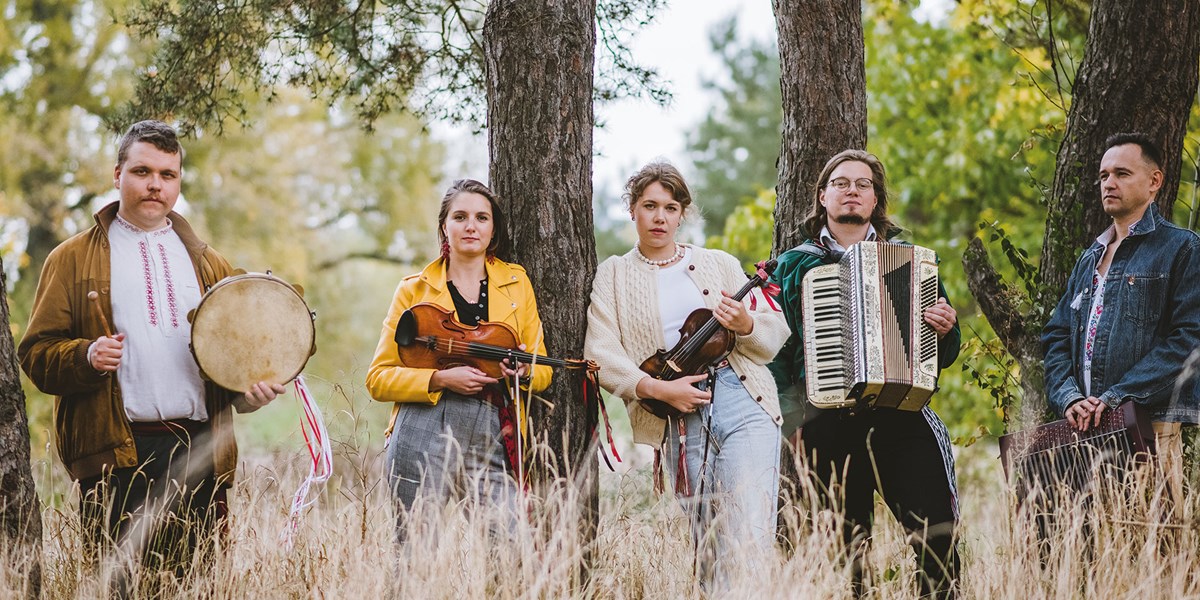
Hajda Banda’s Mateusz Dobrowolski, Daria Butskaya, Nika Jurczuk, Kuba Zimończyk, Paweł Iwan
Somebody said that we are playing music from the world as it should be,” explains Mateusz Dobrowolski, frame-drum player with Polish folk band, Hajda Banda. “First, that folk music is not obscure and forgotten but a living thing that can be adapted in the way the performers want. And, on the other hand, people from different nations are having fun together where borders are not important.”
Hajda Banda play music from Poland’s border zones in the east, neighbouring Belarus and Ukraine. This area includes Polesie, a wetland area in eastern Poland and beyond. Old archive photos show wooden boats as the main transportation. It remained relatively isolated and its distinctive music was well-preserved. The 19th-century Polish ethnographer Oskar Kolberg dedicated volume 52 of his 84-volume collection of tunes to Polesie and Belarus. The group also play music from Podlasie, further north towards the multicultural city of Białystok, with its mighty Białowieża Forest.
The bandleader is Daria Butskaya, a violinist and singer who was born in Minsk, Belarus, but has been living in Poland for the last decade. “My mum, Svetlana Butskaya, is a singer… She also sings Russian and Ukrainian folk songs, as well as Belarusian, so a lot comes from my family. I started to play classical violin when I was five or six and was involved with music from an early age.”
When she was younger, Daria and her mother were involved with Teatr Węgajty, an alternative Polish theatre company near Olsztyn working with folk song and ritual theatre. In Belarus, she also organised collecting trips, mainly in the east of the country and Russia. “People are very kind, and they want to share their music. They are pleased you’ve come from the city. It’s important for them to share the songs because in this way they can be preserved.”
I’ve come to see Hajda Banda in Alchemia, a basement venue beneath a bar and restaurant in Kraków. The group is one member down as Nika Jurczuk, the other female singer and violinist, is unwell. However, it’s still a lively evening with the other band members on accordion, cymbały (cimbalom) and bęben obręczowy (frame drum). The audience is pretty young and very ready to dance. The band make it easy, except for starting with a piece in 5/4.
It’s the title-track from their new album Niepraudzivaya (False), a wedding song saying that just as the viburnum tree states it won’t bloom, the young girl says she will never marry. But when the time comes, the viburnum blooms and – with the help of matchmakers – the girl gets married. In the old days, marriages were often arranged by parents, contrary to the wishes of the couple. The band play me a recording of the Belarusian original – collected by Siarhei Douhushau, a friend of Butskaya – which is in a solemn 5/4 and includes several voices. Hajda Banda’s version sets their polyphonic voices to fiddles, accordion and cymbały while the rhythm is fizzed-up to 10/8.
Most of Poland’s traditional tunes are in three beats (the mazurka, oberek and polonaise), but as you head east (and south), two (or four) beats predominate and polyphony, which isn’t heard in Polish music, becomes more common. Certainly, most of the songs on Niepraudzivaya are polyphonic, but while the originals would have been a cappella, Hajda Banda add instruments and percussive rhythms into the mix.
Kuba Zimończyk plays a three-row Polish accordion from the 1950s, and Paweł Iwan plays cymbały, a type of instrument found only in Poland’s eastern Rzeszów region (where Iwan comes from), but common in Belarus and Ukraine. Both instruments fill out the harmonic middle in the music.
The cymbały is prominent on the instrumental four-beat polka ‘Od Cymbalistów’, which takes two tunes from a book on hammer dulcimer players by Piotr Dahlig. The cymbały plays arpeggiated phrases careering all over the instrument with violin melodies racing over the top. Belarusians tend to play much faster than Poles, but Iwan says he doesn’t believe it was ever played at the speed marked in the book. It still sounds pretty furious the way that Hajda Banda play it. “I’ve really invented my own style of playing,” says Iwan, “I just beat the crap out of it!”
On their first album, Hajda Banda included a Belarusian tango, from the urban tradition. Tango was hugely popular between the wars, when much of western Belarus was under Polish rule. And there’s a similar example on their latest. ‘Kyiv-Minsk’ features two waltzes from those cities across the borders. The first was composed (by Platon Maiboroda) in 1950 for Kyiv University, and has become the city’s unofficial anthem. The second is more sentimental, learned from Minsk’s Rada folk group, with whom Svetlana Butskaya sang from time to time.
Hajda Banda emerged from a Gaude Polonia scholarship that Butskaya won in 2021 to research the music of Polesie, where she had made collecting trips. “I found so many nice songs and melodies, I decided to form a band to play them, and I was recommended to work with these guys.” They bring years of experience and give it the feel of an authentic village band. ‘Hajda’ is a word meaning ‘let’s go’ or ‘forward’ in that eastern region.
Hajda Banda won two prizes and the important audience award at Polish Radio’s New Tradition Festival in 2022, and they’ve gone on to be nominated in the Upbeat Awards and have recently won the public vote for Songlines’ Best Album of 2024 for their debut Hajda!.
Bęben (frame drum) maestro Mateusz Dobrowolski is an accomplished player on this most versatile of instruments to generate endless variations of duple and triple rhythms. He conducts frame drum workshops and is part of the ongoing revival of the instrument in Poland (as well as being a Songlines contributor).
Before WWI the frame drum was played throughout Eastern Europe but, when the Russian Empire collapsed, drums in each country evolved. As Poland was richer, the frame drum fell out of use, replaced by drum kits. A Polish revival started in the 1960s, thanks to the folk music competition in Kazimierz Dolny and, more recently, players like Maciej Szajkowski (of Warsaw Village Band) and Piotr Piszczatowski (of Janusz Prusinowski Kompania) and the Mazurkas of the World Festival in Warsaw (since 2010). Dobrowolski says: “Based on data I have from drum makers, around 500 frame drums have been produced and sold in Poland in the last 10 years. Szajkowski reckons that in the entire 1990s it was probably five.” Dobrowolski has a Ukrainian-inspired frame drum bearing a picture of the holy Virgin holding a (UK-produced) NLAW anti-tank weapon now used in the Ukrainian war.
Hajda Banda had performed in Warsaw, but their first concert outside of the city was in Białystok, a day after the Ukraine war started. The organisers asked whether it should go ahead. For the band, it was more important than ever. “Our final concert that weekend was in Kraków,” says Dobrowolski, “we sold many more tickets than people came, because many of our friends totally changed their lives to become volunteers supporting the refugees arriving at railway stations and so on.”
Interest has been growing in the music of the eastern minorities in Poland – the Łemks, Boyks and Rusyns and the cultures over the eastern borders – which has been a result of Poland recognising its position between east and west. “Even before Poland split from the Eastern Bloc [in 1989], people were really crazy for Western culture because they’d been deprived of it for years”, says Dobrowolski. “But in the past years, the trend has been to accept our Slavic connections, and the full-scale invasion of Ukraine has really enforced this.”
This is an important reason behind Hajda Banda’s success, though even more important has been their musicality and the thrill of hearing talented acoustic musicians who know exactly what they’re doing.