How Glastonbury is rethinking Indigenous and traditional music | Songlines
Thursday, August 21, 2025

How Glastonbury is rethinking Indigenous and traditional music

By Erin Cobby

Erin Cobby reports from this year’s Glastonbury Festival, where programmers are working to integrate diverse global voices into the line-up
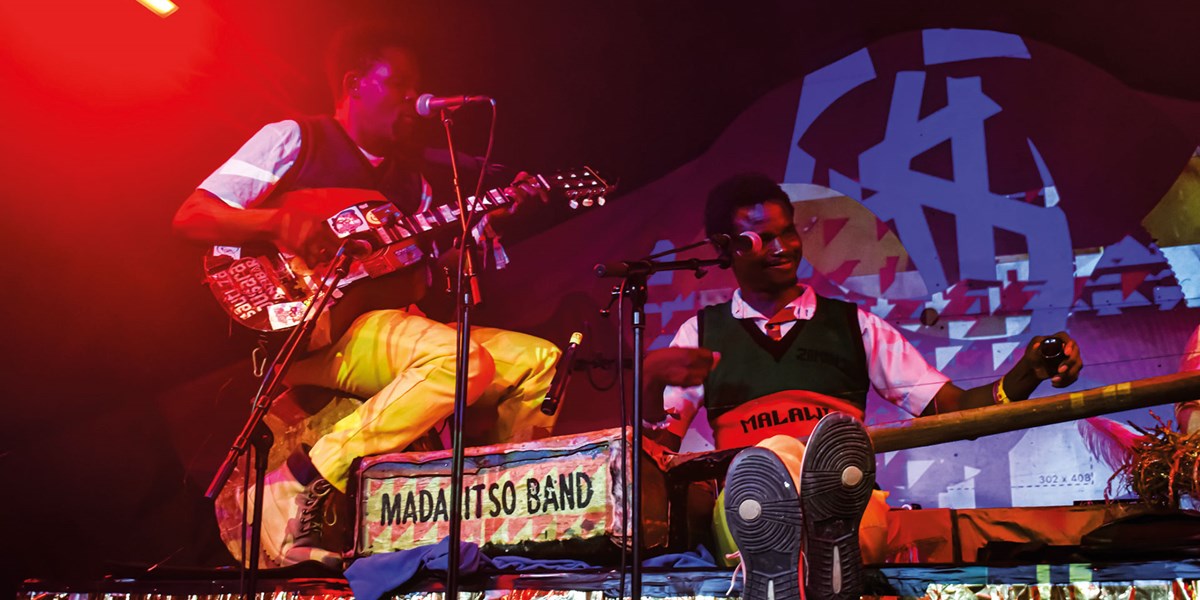
Madalitso Band DSC 0306

Madalitso Band

It’s 1am on Sunday at LORE in the Shangri-La area of Glastonbury, and Malawian musical duo Madalitso Band are about to perform. Acoustic foot drums and homemade instruments like the babatoni aren’t typical of ‘standard’ late-night programming at the festival, but that’s precisely the point. Wanting to move away from an idea that traditional or acoustic music is something for the daytime, LORE (a new stage described as “a hotbed of raw sound and rebellion”) decided to put the Malawians in one of the most high-energy sets of the weekend. “Although it’s acoustic and stripped back, it’s still 4x4 music”, explains co-programmer Laurence Walker. “[Madalitso Band] delivered just the same energy and tempo as the breakbeat hardcore you might find in the fields of a free party somewhere deep in Norfolk, or a squat party in north London.” This energy was reflected by the crowd, who, sweaty in the packed tent, surrendered themselves to the staccato trills and hypnotic rhythms. The duo themselves remarked on this, stating their excitement that the crowd “got into the ecstasy of it all, as that’s what the music is all about.” They loved that the crowd was made up of young people, instead of agogos (grandparents), with the audience on their feet rather than seated, which is often the case at their normal daytime slots at European festivals.

Glastonbury has long prided itself on being “proactive in embedding diversity and inclusion” and, as a result, it has faced criticism when it hasn’t lived up to those ambitions. In the past, it has been called out for tokenistic line-ups (DJ Bushbby lamented in 2023 that the festival needs to strive for “authentic representation top to bottom”), platforming acts and DJs to potentially appear more diverse without affording them the attention they deserve. This concern is echoed by Cami Layé Okún, a DJ selector and radio host from Cuba, who played an incredible set on the festival’s Friday night. While asserting that Glastonbury is making steps in the right direction, she warns more generally: “If not handled with care, traditional or Indigenous programming can easily become extractive or tokenistic. There’s a risk of decontextualising these sounds, stripping them from the communities and cultural lineages they come from. Without deep engagement, festivals and institutions can inadvertently reproduce the very colonial structures they may claim to challenge.”

So, how does a festival provide spaces for attendees to engage meaningfully with traditional and Indigenous culture? One way in which this was explored was through audience participation. At a very early slot in the proceedings, Dele Sosimi led a workshop entitled ‘The Fundamentals of Afrobeat’, in which he broke down a number of his tracks into four parts, and proceeded to try and teach each one to a section of the crowd. By learning words in Yoruba and Pidgin English and singing them back to Dele (albeit with varying levels of success), the crowd ceased being spectators, becoming collaborators in a richer shared experience. They also left with a better understanding of the building blocks of a genre and a greater ability to connect with lyrics in a language other than their mother tongue.

Programming traditional and Indigenous music can also feel perfunctory when no mention is made of the harm colonial states have inflicted on the nations from which they are extracting culture. This is partially explored by the folks at Terminal 1. Launched in 2024, this stage uses salvaged materials from the demolished Heathrow Terminal 1, transforming a site of restricted transit into one of celebration and resistance. This year, to punctuate this point, participants were asked a question from the UK’s citizenship test to gain entry to the experience. Incorrect answers meant being sent to the back of the queue, recreating the frustration and uncertainty felt by migrants and asylum seekers. Although not explicit, by placing the issue of immigration at the centre of a Glastonbury stage, and encouraging direct participation, it forces some reckoning concerning the role the UK has played in the forced migration of displaced groups, often the same groups festivals are so keen to have on their line-ups. One group to perform there was GRRRL, a project bringing together revolutionary women from all corners of the globe. The energy during their electronic-heavy set was powerful, with MC Yallah from Uganda providing lightning-fast lyrical licks alongside the incredible voice of UK-Bangladeshi vocalist Sohini Alam, while a small but dedicated crowd danced exuberantly in front. Though audience interaction didn’t make its way into the set itself, and it’s hard to imagine immigration issues were at the forefront of any of the dancer’s minds, the group personified the stage’s spirit of cross-cultural collaboration, and a positive experience was had by all, with Yallah stating: “I’ve been to a lot of festivals, but there’s something about Glastonbury. I didn’t want it to end.”

According to Hannah Kendaru, programmer of the Temple Uprising stage and a breathwork therapist, a key way to avoid spectatorship is to examine purpose. Temple Uprising began two years ago as a way to honour the free party origins of the festival while dealing with the notion of throwing a party during a time of ongoing conflicts and genocides, from Palestine to Sudan. It was in this space that a Toltec Mexican and Mayan group led a ceremony honouring the elements through singing, chanting and the playing of an elongated bugle-like instrument called a hom-pak. Conducted in the round, on top of a stunningly intricate mandala interwoven with spaces for fire and bowls of water, the ceremony leader spoke in a language whose meaning was lost to us, inviting participants into the space by rubbing clay on their faces. Not everyone seemed to be sold, with people running over the mandala, talking among themselves, and shaking their heads when the clay was proffered. While this may have been interpreted as a sign of disrespect, Hannah reminds: “The idea of awarding gravitas by being serious and silent is actually quite a Christian thing. In their original context, these ceremonies are happening in communities with crying babies, roosters and dogs. There’s always noise and sound – and there’s always something else going on.”

Furthermore, this ceremony also provided a therapeutic process for the masses of people moving through the South East Corner (the festival’s space for late-night antics after the live music stages close) during the festival. “People often lose themselves in getting fucked up in South East Corner,” says Hannah, “and in this way there’s a lot of grief in the space, so the ceremony was done to honour the depth and weight of this emotion and also invite harmony and balance to start the festival off.” By centring the communal benefits of the performance, Temple Uprising created an authentically collaborative experience.

Another way to avoid extractivism when programming traditional or Indigenous music is to create sustained relationships, as exemplified by the Waraloo ceremony, which took place every night at the Arcadia stage at this year’s Glastonbury. Arcadia started in 2008 and repurposes military hardware into gigantic stages, equipped with lasers and/or flamethrowers and shaped like creatures such as a dragonfly [pictured on p44]. The relationship between Arcadia and the Wadjuk Noongar Nation started over a decade ago, when an intern recommended that Arcadia bring the spider to Perth, Australia, as part of a performance that would include an Indigenous ceremony. To facilitate this, co-founder Pip Rush insisted on honouring the traditional custom of sending a message stick and invited Wadjuk Noongar member Barry McGuire to Glastonbury to learn more about them. Impressed with the team’s respect for his customs and their dedication to turning machines of war into a site for community, Barry agreed to work with the company to release ancient songs with a drum’n’bass edge as a way to reach a broader audience. This was momentous, as these songs had not been performed outside of the community since Barry’s ancestors performed for the Duke and Duchess of York in 1901, when the treatment they faced led to the Wadjuk Noongar halting public performances. Barry says: “It was the British who colonised us, but by working with the Arcadia team, we are righting the wrongs of the past. We’ve used ancient songs and drum’n’bass’d it up, and bring together communities who love music, so the music can be theirs too.” This way of collaborating was initially rejected by white programmers in Australia, who, as Pip states, tend to want to keep Indigenous culture “in a glass case”, trotting Indigenous folk out for a spectacle, only to send them home immediately afterwards. Arcadia offered a chance for real cultural exchange, which the Wadjuk Noongar community greatly welcomed. The results of this decade-long relationship have been far-reaching, from Barry sharing a booth with Fatboy Slim, to petitions calling for their initial collaboration with drum’n’bass producer Rob Blake to be made Australia’s national anthem. This year saw Barry in the belly of a gigantic dragonfly, pulling in 65,000 people to witness a new collaboration, the Waraloo Dragonfly Show. Playing boomerangs and dressed in traditional garb, Barry brought the ancient songs of the Wadjuk Noongar nation to Glastonbury, and helped drive home both the message of the music and the dragonfly stage itself, that it’s time to adapt for the world to come.

As more and more people are reclaiming their heritage and platforming the music and practices of their (and others’) ancestors, collaboration, care and consent must be at the centre of all programming to avoid tokenistic and harmful action. Like Cami states, “These traditions are not trends. They are living cultures, deeply rooted and continually evolving – and they deserve respect, space and justice, not just symbolic inclusion.”

Subscribe from only £7.50

Start your journey and discover the very best music from around the world.

Subscribe

View the Current
Issue

Take a peek inside the latest issue of Songlines magazine.

Find out more