Thursday, September 25, 2025
Kayatibu: Forest Rock from the Amazon
By Erin Cobby
Erin Cobby speaks to Kayatibu, Indigenous Brazilians who are amplifying the Amazon with a message of preservation and unity
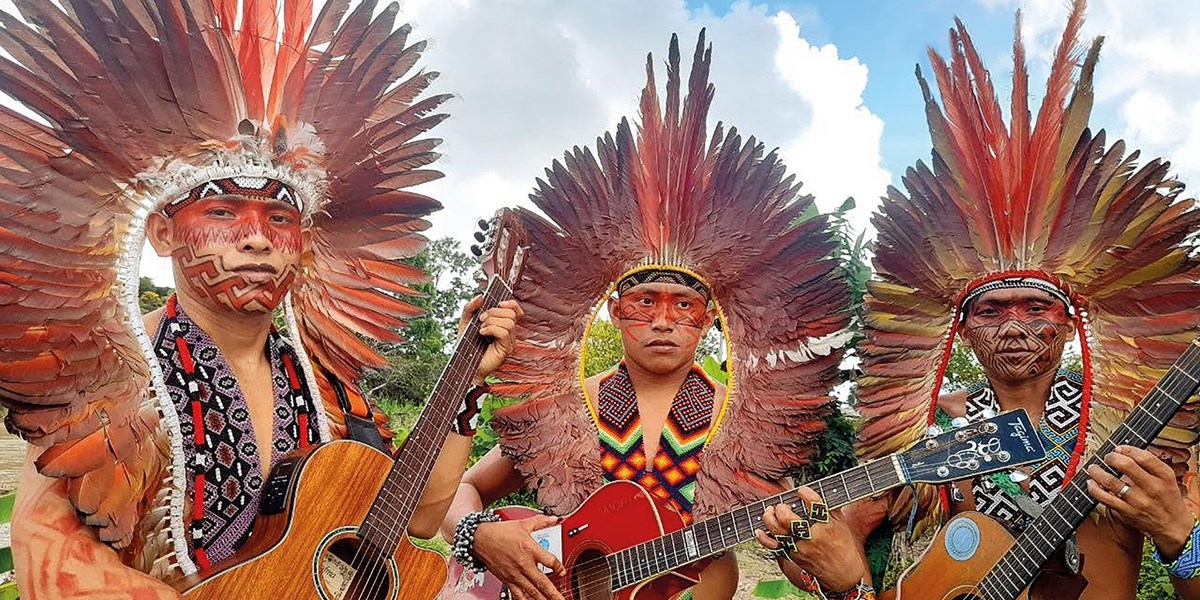
Txai Shane (Abraão), Txana Tuin (Cleudon) and Shane Saite Maspã Huni Kuin, who sings ‘Nuku Bari Yuxibu’, the last track on Ni Hui (Luiz Gabriel Lopes / Paulo Novaes Archives)
The growl of an electric guitar echoes through the Amazon, heard amid cries of ancestral chants and the patter of ceremonial drums, while birdsong and croaking amphibians add to the rich, unexpected sound. This is rock da floresta (forest rock), a new genre born from a collaboration between Kayatibu, formed by members of the Huni Kuin community of the Brazilian Amazon, and Minas Gerais producer LUIZGA (full name Luiz Gabriel Lopes).
When they appear on Zoom, the young Huni Kuin musicians Byxku Yuraya and Shane Saite are midway through a European tour for their new album Ni Hui. Wearing sleeveless vests and sunglasses, they appear every inch the rock stars their psychedelic new sound denotes. When asked if they’re a fan of the term ‘forest rock’, they roar with laughter. Luiz, acting as translator, offers a simple explanation: “yeah, they like it!”
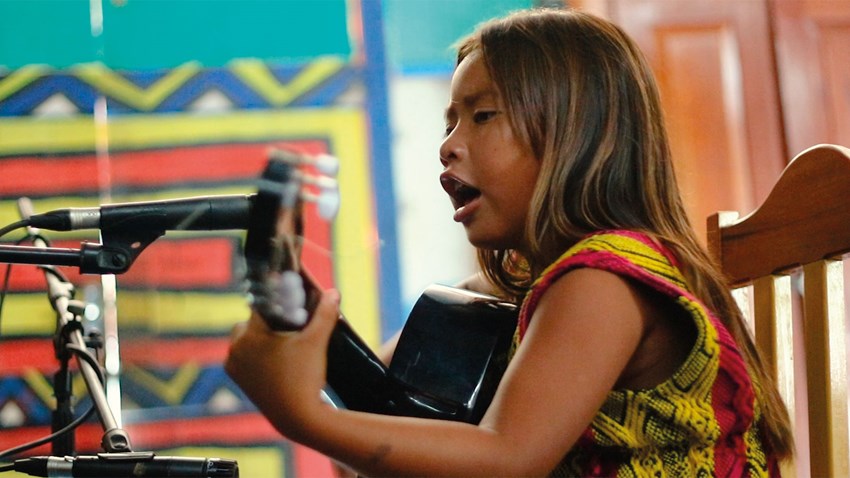
Maspã Huni Kuin, who sings ‘Nuku Bari Yuxibu’, the last track on Ni Hui (Luiz Gabriel Lopes / Paulo Novaes Archives)
There’s an impression something is lost in translation – but, whatever the joke, the description fits. Their music is both moving and ecstatic, with threads of percussion and electric guitar accompanying layered voices. Field recordings from the Amazon are weaved into the music, transporting listeners to the rainforest – yet also imagining a world beyond our own. This is best exemplified by the title-track ‘Ni Hui’, translating as ‘voices of the forest’, in which we hear the buzz, croaks and chirps of different creatures coming to life, before hand drums and electric guitar slowly fade in. Luiz explains the decision behind placing the tropical soundbite at the start of the record: “As a producer, I wanted to create a sensation [for the listener] that we are entering this territory we don’t know a lot about. It was a bit like creating a gate to where I’m standing.”
The Huni Kuin live in a region of the Amazon rainforest in Brazil’s Acre state, and also in Peru. Luiz met the Huni Kuin when he was invited to their community – only reachable via boat – through a funded residency in 2019. Across two weeks, he worked with 30 young Huni Kuin musicians, resulting in the first Kayatibu album Ni Ishanai (2022), an expansive 18-track effort that packed in a multiude of voices and field recordings. In comparison, Ni Hui was conceived as a more comprehensive album, with Luiz sitting down with Kayatibu members at the start of the project and collectively deciding the shape of the work, including who was going to sing on what track and what instruments Luiz would overdub at the end. In this way, it was a much more intentional process.
From the instant they began collaborating, it was immediately clear that Kayatibu had a different way of approaching music. As they traditionally did not use instrumentation, the Huni Kuin community created musical layers all through a capella, layering voices to create rhythms and harmonies. Shane refers to this style as “natural voice”, with many of the same lyrics being put to different melodies as the musical tradition experiments and expands. In this way, songs are often part-improvised, with traditional chants being placed over new structures.
When the Huni Kuin did use Western instruments, having been introduced to some Western music in the 70s, the Indigenous group played them differently. “They use the vocabulary of Western tonal music but combine the chords and melodies in very unexpected ways,” explains Luiz. “Their perception of timings is very different; they aren’t totally colonised by a 4/4 drumbeat or have the perception that tempo needs to be divided into equal parts. That is what is magic about Huni Kuin music.” For Luiz, playing with the Huni Kuin was a process that required him to let go of the musical notions drummed into him at Western music schools, like time signatures and song progression.
When Shane describes the circularity present in his community’s music, he touches on something far bigger than just tempo. “Music is vibrating on the Jibóia power,” translates Luiz, a word which, after some deliberation, is settled as meaning “anaconda.” However, they clarify that this is not a simple snake, but a spiritual snake entity of the forest, whose circular manifestation is a metaphor for how time is measured, both in life and in music.
Such a profound and layered answer to a simple question about tempo offers a glimpse into how deeply music is woven into Huni Kuin life, and above all, their spirituality. This crops up again when the group is questioned about the meaning behind their songs. “This is a big topic,” says Luiz, answering before launching into a lengthy back-and-forth with Byxku and Shane.” Their songs talk about the main forces and energies on the planet: the wind, the forest and the land,” explains Luiz. He then translates the meaning of a song ‘Nai Mãpu Yubekã’ – this is a song featured on a different album, TXAI BAND (2024), which Luiz made with Brazilian singer-songwriter Paulo Novaes and the Huni Kuin community, including some members of Kayatibu. In Hancha Kuin (the language of the Huni Kuin), the title translates as ‘snake bird sky’ (“nai” is sky, “mapu” is bird and “Yubekã” is the Jibóia snake).
While no further explanation is offered, or perhaps can be translated, this pictorial approach to language illustrates another difference between making Western and Indigenous music. Luiz adds that, “there isn’t a grammar book you can learn Hancha Kuin [the language of Huni Kuin] from. So, you can only learn by discussing with elders, and even then, there are no absolute truths. Each person will translate a word differently. It’s a language with a lot of substitutes.”
It is important to highlight the medicinal role that music serves in their society – specifically in ayahuasca ceremonies, central to the community’s well-being. Luiz explains that the plant itself is treated as a shaman, and is what Shane credits with empowering him to follow his artistic path.
Shane and Byxku go on to say that each song often has a very specific purpose within the use of this medicine, whether that’s to help bring back the mental clarity of someone who has just taken ayahuasca, or to help enhance the colours of the visuals someone experiences while undergoing treatment. This practical role in the ceremonial space shows how central music is to the community at large. “It’s the oldest and longest line that connects them to their most ancient traditions,” explains Luiz. “Everything goes through the music as a magical force, it weaves and connects.”
With this context, when Shane and Byxku start chanting an ayahuasca ceremony, the significance of the songs becomes clearer. It’s as they say themselves: “Nawa music [non-Indigenous music] is nice for dancing. But Huni Kuin music heals your heart and your spirit. It’s rooted in spiritual tradition. Ultimately, it’s a way to pray.”
This is the message they hope the latest record can share with the world. “They’re trying to bring a bit of the power and the spirit of the forest into the world to help heal it,” explains Luiz. “To collaborate with nawa music is to embody the spirit of togetherness that they hope can engender deeper connection.”
The implications of this go beyond music. The Huni Kuin make up only one of approximately 305 Indigenous communities in Brazil, all of which are facing their own issues regarding, but no means limited to, land access, legal recognition and disappearing languages. Luiz states: “Some populations in this area have been travelling far from home to get enough resources together to buy back land that was always theirs. This is the imbalance of the colonial world that we’re still feeling today.”
He goes on to describe how the Huni Kuin, estimated to make up around 12,000 people, are in a better position than some other Indigenous populations and actually have a voice in local government. The Vice-Mayor of Jordão – the closest municipality to where the community live – is Huni Kuin, and there’s even a councillor who is part of the Kayatibu project itself (providing vocals for Ni Hui’s ‘Kuxipa Kayaway’), connections that allow the group some influence on the laws governing their lives.
In its way, this musical project broadly weaves into the fight for Indigenous rights. By sharing their music, the Huni Kuin are trying to ensure that their language won’t be forgotten, safeguarding it for future generations by sharing it with the world. They are also raising the profile of their community and, in doing so, platforming a relationship with nature and the land that is sorely needed in our current time of climate crisis.
+ Ni Hui is out now on Da Lata Music