Thursday, June 12, 2025
Lido Pimienta rewrites the score, turning orchestral tradition on its head
For her latest project, Colombian singer Lido Pimienta wanted to shake off the shackles of categorisation and do what nobody expected her to do
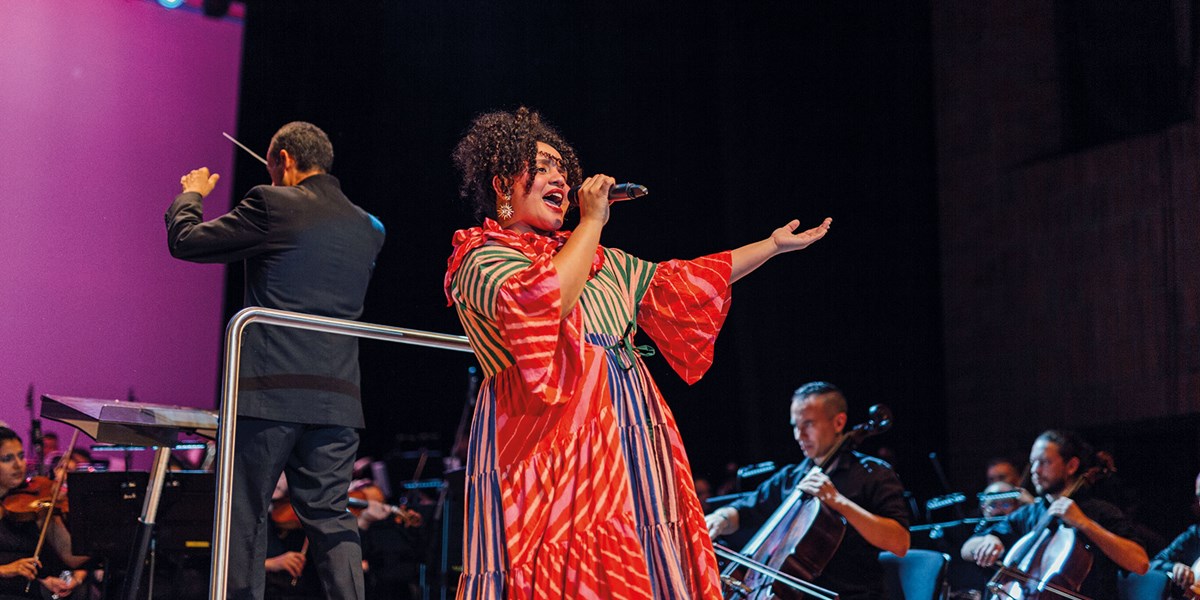
Pimienta performing with Filarmed in Medellin, October 28, 2023, her first show with an orchestra (photo: Yohan Lopez)
La Belleza began as a joke, a response to being categorised as ‘world music’. “I looked at the press for [2020 album] Miss Colombia,” says Lido Pimienta, “and joked to myself: ‘I’m going to make an orchestral album. I’m going to make the most Western, European music’… then where are they going to put me? That question was the genesis of this music.” Throughout our interview, her question remains rooted in physical placement – in which shop aisle the record would be placed. In contrast to the Latinx-tinged pop of Miss Colombia, La Belleza deals in maximalist orchestral flourishes and avant-garde vocal takes like ‘El Dembow del Tiempo’, perhaps the clearest synthesis of the Afro-Latin sounds and rhythms from her previous work, and the European musical influence adopted for this release.
Appearing at a hair’s width past the halfway point, on the original draft of the album ‘El Dembow del Tiempo’ was initially the first moment in which Lido’s voice was heard. However, she was eventually persuaded to sing throughout the album by choreographer Andrea Miller (who had asked Pimienta to score a piece for the New York City Ballet in 2021, Pimienta’s first time composing for an orchestra). Pimienta reflects on the inclusion of her voice: “It’s important to be a Caribbean woman who uses her voice, when historically you’ve been silenced. It’s important to make people feel uncomfortable.”
Lido’s attitude towards classical music has changed a lot since she collaborated with the New York City Ballet Orchestra. She used to see the genre as just another leftover of post-colonial art, nothing more than “an expensive cover band”, as she puts it. But slowly, she became convinced, seeing it as a “human community, everybody working towards the same thing.”
In composing for La Belleza, she was aware of her lack of formal training: “I’m not a university musician, I’m an oral-tradition-in-the-streets-of-Colombia musician… so I said to myself, just treat it like any electronic song. Every section of the orchestra is just another synth sound… I always say that a song is good when you don’t need anything to perform it. And I think that comes from my education in Afro-Colombian music and performance, where your main instrument is your voice, your hands and maybe some drums. I also come from a place where there are regular blackouts: no electricity, no water… so you build yourself as a [hi-fi] speaker. Everyone is a speaker, everyone is a dancer, a singer, musician. It’s just inherent. So, it was really important for me that my compositional skills came through – that the arrangements were speaking for me, acting as my ‘voice’ even if not my words.”
This album would not exist, she says, without the 1970 Czech arthouse masterpiece Valerie and Her Week of Wonders. If you’ve not watched the film, you could do worse than Lido’s summary, as she takes on the role of a gossip columnist hamming it up for camera: “[It’s about] *gasp* the sexual awakening of a 13-year-old girl, and this priest who is obsessed with her *gasp*, and her evil auntie is also obsessed with him but hates her *gasp*. It’s like a Czech telenovela.” The film is surreal and deeply symbolic, a feast for the eyes in all its pre-digital glory, and according to Lido, it’s “a full, complete work of art.” The theme of the pressures thrust on young girls to adhere to impossible, and Eurocentric, beauty standards is nodded to in the new album’s title. “From a young age, we’re told that we’re not [beautiful], and that it’s something we have to aspire to, and that we have to change our personas in order to better fit into this narrow-minded narrative of beauty.”
The soundtrack to Valerie was composed by Luboš Fišer, whom Lido playfully deems “a freak”, ahead of his time. The Valerie score is “so modern! When I listen to it, I want to sample a bunch of the passages and add trap beats to them.” Echoes of Lido’s beloved Valerie can be heard in the stacked vocals on ‘Ahora’ and the tinkling of the instrumental in ‘Mango’.
But at its heart, La Belleza is “an ode to the Caribbean sublime.” Pimienta is fixated on the idea of the sublime, a leftover moment of post-colonial analysis from her previous life as an art critic and historian. “When we speak of the sublime, we talk about, pictorially, the white man looking into the distance, facing nature… because he’s ready to conquer it. To me, what the sublime is, is a woman with a child on her hip, walking down the street. Or going to the market, with her rollers on… that’s sublime to me.”