Thursday, April 9, 2026
Rainforest World Music Festival 2026
One of the world’s great music festivals, set in Borneo’s living rainforest

It is the setting that makes the Rainforest World Music Festival (RWMF) unforgettable. Even for those unfamiliar with Sarawak, RWMF is recognised as one of the leading world music festivals globally, a reputation it has built over nearly three decades, with its 30th anniversary approaching next year. Set against rainforest-covered mountains and the South China Sea, it is as much an experience of place as it is of music.
Sarawak is Malaysia’s largest state, on the island of Borneo, distinguished by its remarkable cultural diversity. With more than 34 ethnic groups, its communities form a rich cultural tapestry – where different traditions, languages and musical expressions coexist, shaping a cultural landscape that is both deeply rooted and continually evolving.
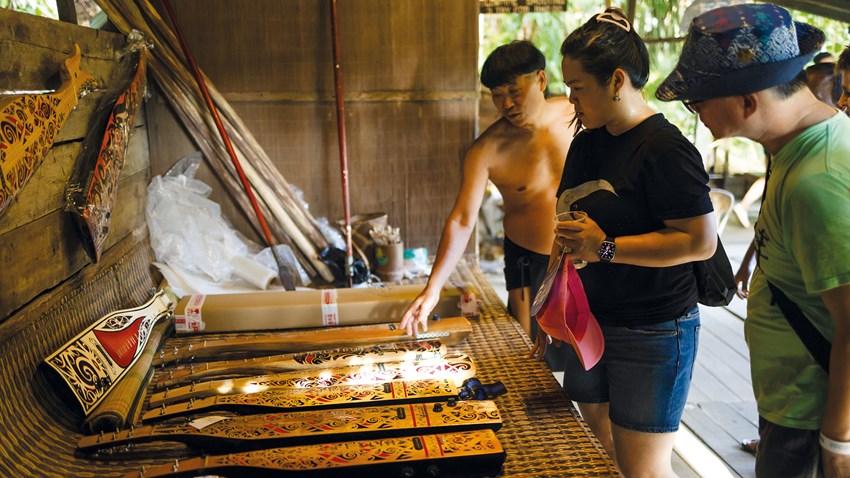
Sapé-making demonstration
This sense of diversity finds a tangible expression at the Sarawak Cultural Village, where RWMF takes place at the foot of Mount Santubong, just outside the capital city of Kuching. More than a collection of buildings, the village is a living museum that brings together the cultures and traditions of Sarawak’s many communities. Set around a lake and framed by forest, visitors move between traditional dwellings representing groups such as the Iban, Malay, Chinese, Bidayuh, Orang Ulu, Penan and Melanau, encountering distinct ways of life through architecture, craft, dance, costume and daily practices – offering a cross-section of Sarawak’s cultural heritage within a single visit.
It is within this cultural landscape that the music of Sarawak takes shape. The region’s most iconic instrument is the sapé, which has come to resonate far beyond its place of origin. This boat-shaped lute, created by the Orang Ulu communities deep in the island’s interior, is often adorned with intricate motifs that echo the curling forms of forest vines. Its sound is delicate and meditative, once played within the intimacy of the longhouse, sometimes in healing rituals. Traditionally strung with forest creepers, now usually with guitar strings, the sapé has evolved while retaining its deep cultural significance.
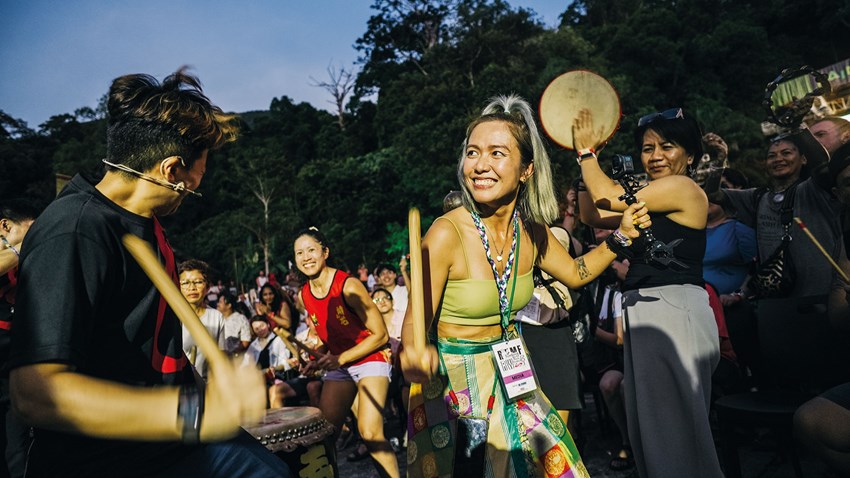
Festivalgoers get involved in a drum circle
More than an instrument, the sapé has come to embody something of Sarawak itself. Its flowing melodies echo the movement of rivers and the rhythms of the rainforest, at times evoking the hornbill’s call. In both its traditional and electrified forms, it connects contemporary audiences to the ancestral roots of the land.
This deep connection between place, culture and sound is what defines RWMF today. From modest beginnings in 1998 with around 300 attendees, RWMF has grown into an internationally recognised event, drawing around 20,000 visitors over three days. Its appeal lies in the juxtaposition of local and international acts, where audiences encounter Sarawak’s musical traditions alongside artists from across Asia and beyond.
By day, workshops and intimate sessions allow visitors to engage directly with musicians, instruments and craft traditions up close. By night, the rainforest setting transforms into a vibrant stage beneath the silhouette of Mount Santubong. This year, RWMF will feature over 200 performers from 12 countries, including American soul greats The Commodores featuring Thomas McClary, Malaysian cultural icon Datuk M Nasir and British band Incognito, known for hits such as ‘Always There’ and ‘Still a Friend of Mine’.
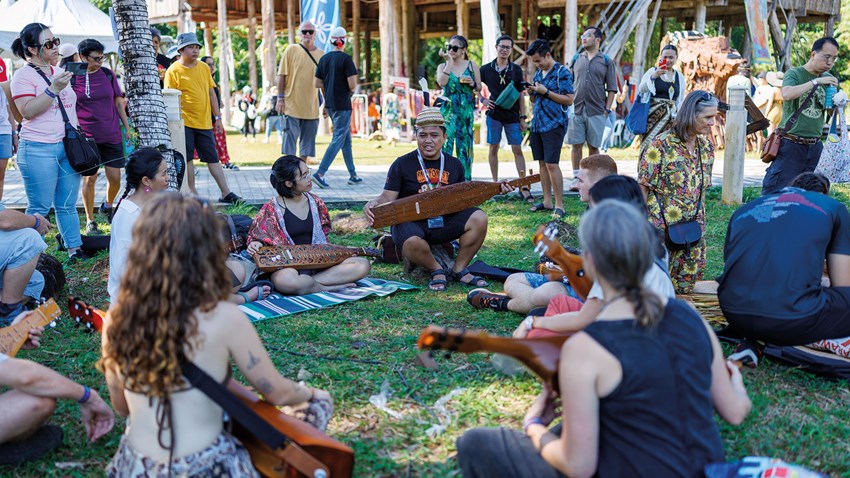
Sapé workshop
Central to the festival’s story is its role in the revival of traditional music – particularly the sapé. Prior to RWMF, the instrument was rarely played, often displayed as decoration in longhouses, a silent work of art. Today, there are dozens of active sapé players, largely due to the influence of master musician Mathew Ngau Jau, now in his seventies, of the Kenyah community.
As a child, he was forbidden from touching the instrument, which was kept out of reach by the elders in his longhouse. When they were out working in the fields, he would climb up to retrieve it, teaching himself to play in secret – a quiet act of curiosity that would later shape the revival of the sapé itself. He went on to become one of RWMF’s defining figures.
Traditionally, the sapé was played predominantly by men, and in some communities, women were discouraged, or not permitted, to play. That dynamic has since shifted, most notably through artists such as Alena Murang, a pupil of Mathew Ngau Jau, and one of the first women to bring the sapé to international audiences.
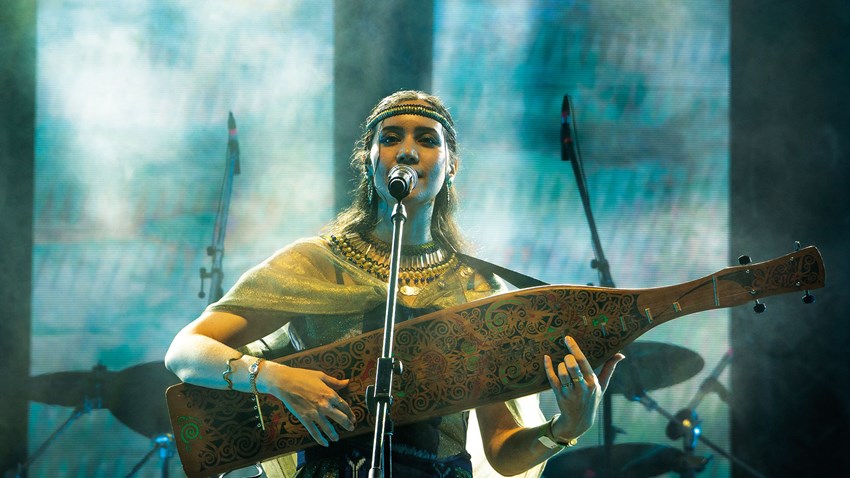
Alena Murang
His legacy continues through the next generation, including through his son Jackson Lian. He performs with At Adau, a band that brings together musicians from different Sarawak communities, reinterpreting the sapé within a contemporary setting while retaining its cultural roots. Adau is the hardwood from which the sapé is usually made.
Mathew Ngau Jau has since been recognised as part of Malaysia’s Living National Heritage, a testament to the instrument’s enduring cultural importance. In many ways, the story comes full circle at RWMF itself, where the sapé – once played within the intimacy of the longhouse – now sits at the heart of Sarawak’s musical identity, even reflected in the festival’s own imagery through the silhouette of a sapé player in its logo.
From here, the festival is a point of departure. RWMF offers an introduction to Sarawak’s cultural and musical traditions, but travelling even further into the state will allow those experiences to unfold within their original context, where culture is not staged, but lived.
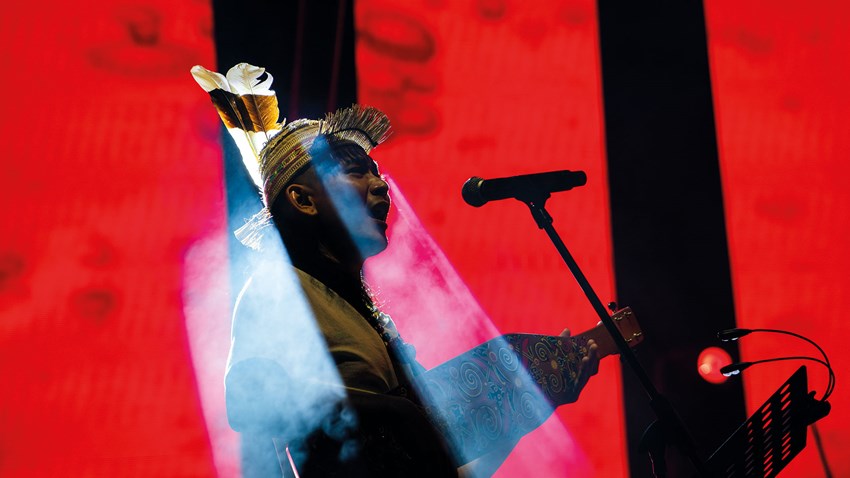
Ezra Tekola
Across Sarawak, community-based experiences remain central to its cultural landscape. Visitors can spend time in traditional longhouses – often described as a village under one roof – where communal living, craftsmanship and daily practices reflect generations of inherited knowledge. Iban and Bidayuh communities are found closer to Kuching, while Orang Ulu communities reside deeper inland, particularly along the Rajang River, where journeys upriver reveal the scale and remoteness of Borneo’s interior.
This cultural depth exists alongside one of Southeast Asia’s most extensive natural environments. Sarawak is home to a network of protected areas. Within easy reach of Kuching, Semenggoh Nature Reserve offers opportunities to observe orangutans within a protected forest setting, while Bako National Park – the state’s oldest national park – presents a diverse coastal ecosystem of mangroves, sandstone formations and wildlife-rich forest trails. There are proboscis monkeys, unique to Borneo, which are a delight to see.
Further across the state, Sarawak’s landscapes expand in both scale and significance. Gunung Mulu National Park, a UNESCO World Heritage Site, is internationally recognised for its vast cave systems and dramatic karst formations, while Niah National Park offers insight into one of Southeast Asia’s most important prehistoric sites, with evidence of early human presence dating back approximately 65,000 years.
Together, these experiences reflect the Sarawak experience – where culture, nature and heritage are not presented in isolation, but experienced as an interconnected whole.
Ultimately, RWMF is more than a music festival. It is an entry point into Sarawak – a place where culture, nature and community remain closely intertwined. For many, it marks the beginning of a deeper journey into one of the world’s most distinctive cultural and ecological landscapes.
WORDS BY SIMON BROUGHTON
The 29th Rainforest World Music Festival takes place 26–28 June, 2026: rwmf.net