Thursday, March 5, 2026
Rhythms of Nagaland: Inside the Spectacle of the Hornbill Festival
Simon Broughton experiences the Hornbill Festival, where Nagaland’s many tribal cultures unite for a spectacular celebration. Photos by Simon Broughton

Log drum in the Chang morung
There are six men either side of a log drum – the immense instrument is carved out of a single hollowed-out tree trunk, with one end intricately sculpted into the head of a tiger. Each performer is wearing a red-and-black shawl, a loincloth and a single-feather headdress. Together, they each beat the side of the drum with a short, upright wooden pole. The rhythm is fast, suggesting celebration – a slower pace would mark a sombre circumstance, such as a death.
We are in the morung (communal house) of the Chang tribe in Kisama, the Naga Heritage Village, outside Kohima in Nagaland, India. There is a morung and other representative buildings for each of the 17 recognised tribes of Nagaland, as well as for the Garo people, who immigrated from Manipur in the south. Most of the tribal complexes have a log drum, traditionally used for summoning a village or clan together. They also serve local food – smoked pork is a favourite – as well as locally produced alcohol: rice or millet beer, and rice wine. The traditional houses are largely built of wood and bamboo; they are wonderfully woven in various styles, and the 17 tribes have their own local craft specialities.
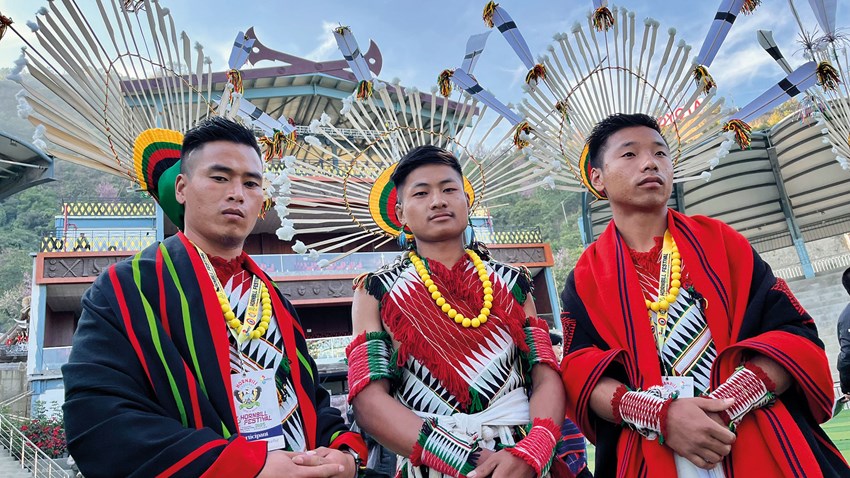
Men from the Angami tribe
All the ethnic groups in the region hold celebrations at different times and places throughout the year – the one exception is the Hornbill Festival. Named after the spectacular local bird – though you’re unlikely to see one – it brings together the diverse music and culture of the tribes, with locals performing alongside international acts. “Hornbill Festival is primarily a tourism project to showcase the rich culture of the 17 tribes to the entire world” says Theja Meru, Chairman of the Task Force for Music and Arts (TaFMA), who organise the event.
Although the large cities of Nagaland – the capital Kohima and the commercial hub Dimapur – have mixed populations of many tribal groups, the 17 tribes are distributed in distinct territories across the state. These range from the Konyak (the largest group) in the north, to the other substantial groups – the Ao, Sumi, Lotha and Angami – in the central region. Kohima and the villages around it are in Angami territory.
For many years, Nagaland was a region of insurgency and foreign visitors were only admitted in 2000, the same year Hornbill was inaugurated. “Hornbill Festival brings India closer to Nagaland and closer to the northeast and vice versa,” says Abu Mehta, advisor to the Chief Minister of Nagaland. “And it promotes this culture to the international community. People are often shocked – it’s not the Indian culture they expect and it hasn’t been exposed enough.”
The 26th edition of Hornbill, which took place last December 1–10, opened with a spectacular mixture of music, choreography and visuals featuring some 450 performers. The show is clearly based on tribal music and ritual, but brought into a compelling 21st-century format – the Irish delegation in attendance likened it to a kind of Nagaland Riverdance, but it was rather more spectacular than that!
From Ireland, Boínn, an offshoot of The Mary Wallopers who formed especially for the occasion, had the difficult task of following the opening show. But the lively quartet of vocals, violin, banjo/guitar, uilleann pipes and concertina changed the mood entirely and got the audience doing a long conga around the arena. The other impressive group from abroad was the Japanese taiko troupe Drum Tao, which featured a woman performing on a massive horizontal drum and a brilliantly choreographed routine that also included flutes and plucked shamisens.
During the day, the arena at Hornbill featured carefully curated performances by all the different tribes, lasting three hours from 11am to 2pm. Each tribe just does one piece, and it changes day to day, so it’s a bit of a lottery what you get; there’s a harvesting song from the Yimkhiung, a warrior dance from the Konyak, a tiger hunt from the Ao, and a kind of dramatisation from the Phom people detailing their migration from their ancestral homeland. Most of the Naga tribes are thought to have migrated to Nagaland from southern China in various waves, beginning to arrive in their present territory from the 10th century BCE.
Musically, the most impressive piece was the Kachari’s ‘Bagurumba’ (Butterfly) dance, boasting an ensemble of bamboo flutes, a bowed sarinda-like instrument and long dholak drums. A group of female dancers in orange and green with red wing-like shawls performed a graceful dance which made clear why it’s named after a butterfly.
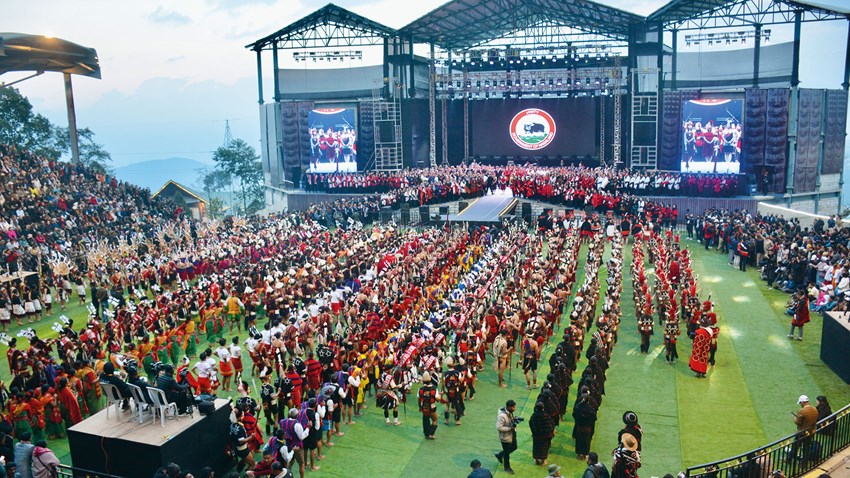
All tribes at the festival opening
These early performances at Hornbill are a great way to hear pure traditional music – well performed and well amplified – but they suffer from taking place in the large arena, which doesn’t suit their intimate nature. However, this is where the morungs of the Cultural Village come in. They are not scheduled, so it’s a bit hit and miss, but wandering round the various morung you can encounter music and ritual dances close-up. I witnessed spectacular dances by the Yimkhiung and Khiamniungan tribes, both of which wear impressive headdresses and circular brass plates over their groin areas. But, for my money, it’s the Kachari who play the most interesting music.
The Kachari are a tribe based around Dimapur, the commercial hub where the Nagaland airport is. Dimapur – literally meaning ‘town by the great river’ – was their capital, established in the 10th century. One of the mysterious legacies of the Kachari Kingdom are spectacular carved stone monoliths in Dimapur. Their designs are mostly abstract arches and circular ‘sun symbols’, but there are also carvings of animals and birds.
The Kachari monoliths – looking like giant haystacks – are depicted on the front of their morung in Kisama. Much of the tribal music in Nagaland revolves around chanting and drumming, but the Kachari have a more sophisticated musical culture with ensembles of bamboo flutes (sifung), bowed four-string sarindas (serja) and dholak double-headed drums (kham). These were played for dances as well as accompanying female singers – and made an exquisite sound.
The only downside in the Cultural Village is the behaviour of the audience; it seems that everyone has an obsession with selfies, wanting a photograph of themselves next to someone in tribal costume, or even getting themselves dressed in tribal costumes, which the local tribespeople were on hand to help with. I asked one of the Kachari musicians if he was irritated by this. “We are very happy to promote our culture, of which we’re very proud,” he says dutifully, but admitted that he found the endless posing quite a pain.
With different programming across the day and night, Hornbill ends up feeling like two separate events. During the day, there’s traditional tribal music, and in the evening, a line-up of Indian rock bands who have competed to win a slot at the festival. The bands mostly stick to the standard rock format of vocals, electric guitar, bass, keyboards and drums with singing in English. Alongside them are the bands brought over by international partners, with acts from Ireland (Bóinn), France (Agniva), the UK (Scottish accordionist RuMac), Japan (Drum Tao) and Korean pop-rock band MongDoll.
“I’m on a mission,” says Theja Meru. “The vision is to help Naga artists be at the forefront of the music business and entertainment.” As part of this, he’d even got Spotify India to curate two evenings of Indian rock bands. It’s a commendable effort to make this festival relevant to 21st-century India.
But for Songlines, the primary interest is the tribal music. Of course, the music of Nagaland’s tribes exists in their respective festivals, but this is the most accessible place to hear it – and it is thrilling. The log drums, the vivid music in the morungs, the roasting pig over the fire and the frothy punch of the rice beer makes Hornbill an experience like nowhere else.
+ Hornbill Festival 2026 takes place December 1–10 in Kohima, India. For more details, visit hornbillmusicfestival.com