Thursday, October 30, 2025
Spotlight: Vumbi Dekula
The Congolese guitar hero speaks to Michał Wieczorek about the peripatetic life of a soukous emissary
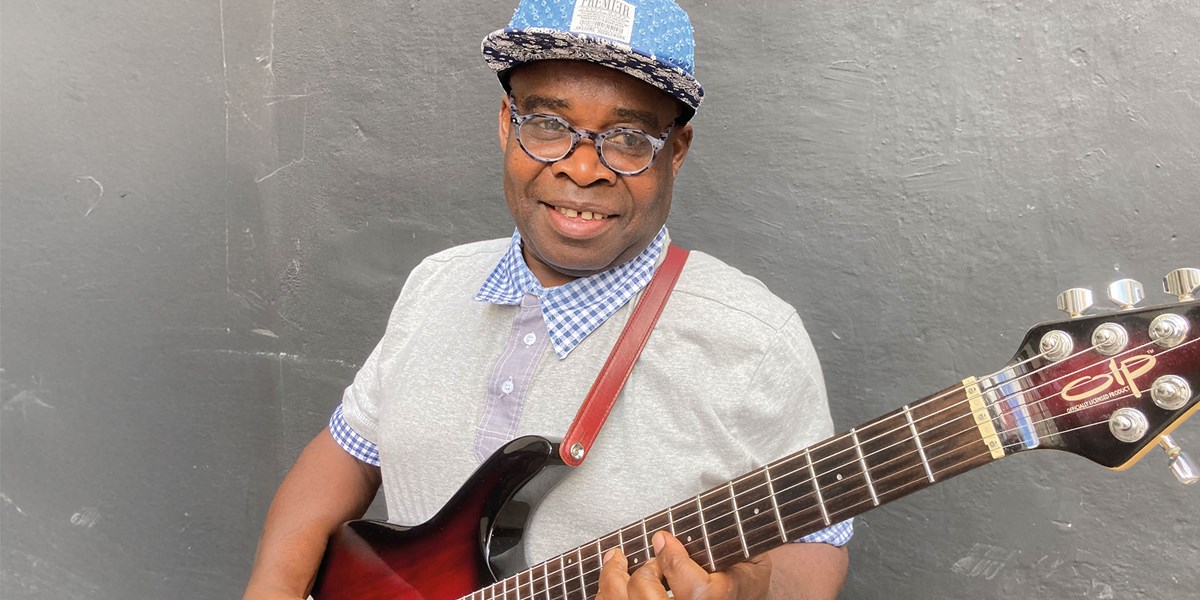
Vumbi Dekula (Karl-Jonas Winqvist)

Kahanga Dekula ‘Vumbi’ (AKA Vumbi Dekula) is a true globetrotter. Born in Uvira, in the easternmost part of Kivu region in the Democratic Republic of the Congo, he has been living in Sweden for almost three decades. “Swedes love to dance, so they love our music. It’s music made to dance”, Vumbi laughs from his home in Stockholm. Before arriving in Scandinavia, Vumbi lived and performed with various groups in Dar es Salaam, Paris and London.
Growing up in a Swedish Catholic missionary home, he took up guitar aged 16, immediately falling in love with the instrument and its Congolese virtuosos, Dr Nico and Franco. “In Congo, everyone loves rumba and soukous. It’s our music.” But native musicians weren’t his only influence. Western artists such as Django Reinhardt, George Benson and Jimi Hendrix were also among his favourites. “I think the foundation of my playing style is a mix of Dr Nico, Franco, Benson and Reinhardt,” he says.
Vumbi played in a few local bands in Uvira before moving to neighbouring Tanzania, where he got a job with Orchestra Maquis Original, a Congolese group that made their career in Dar es Salaam. One of the most popular bands in the country, Maquis performed songs in various genres – pachanga, bolero, bossa nova – fusing them with their signature soukous sound. But, for Vumbi, it wasn’t enough. The quality, production and mixing weren’t up to par with the musical output he was hearing from Europe. “We were recording in the radio studios in Tanzania and thought the quality was fine. But the soukous that came to us from France, the music recorded there, sounded much, much better. I found a producer, Fataki Lusangi, who told me that I should go to Paris and do some recordings there,” Vumbi recalls. He didn’t need to be told twice; he moved to France and the UK before eventually settling in Sweden, where he remains. In Sweden, he first played with the Gothenburg-based African group Mamamaluma before moving to Stockholm to join Ahmadu Jarr’s Highlife Orchestra and form Makonde Band with Sammy Kasule.
Known for his relentless style and tireless work ethic, Vumbi quickly became a sensation on the Swedish scene. In 2008, he decided to take another step, assuming the role of bandleader. The resulting Dekula Band earned their Swedish following in the most traditional of ways: by playing hundreds of concerts. “We just love playing, we played in clubs, at festivals, everywhere where it was possible.” That’s how Vumbi met Karl-Jonas Winqvist, a Swedish producer, musician and owner of the Sing A Song Fighter label. The pair quickly became friends and in 2019 Winqvist released Opika, the first Dekula Band album (with a cover boasting a resplendent photo of Vumbi taken at a 1990 show in Oman). It fully showcases the swag of his music, the skills, ease and enchanting melodies that all emanate from Vumbi’s guitar.
When the pandemic shut down almost all his musical life, Vumbi retreated to the studio to record his first solo guitar record, Congo Guitar. “Everyone loved this record… me too”, laughs Vumbi. Much mellower and sweeter-sounding than Opika, Congo Guitar reveals a more melancholic side to the guitarist’s playing. These albums were followed by the soaring melodies of this year’s Slavery is Crime, an EP featuring solo Vumbi tracks and Dekula Band cuts. “We’re preparing for a tour of Portugal, then we’ll play some shows in Sweden and the rest of Europe,” says Vumbi. An itinerary truly befitting a soukous ambassador.
+ Slavery is Crime is out now on Sing A Song Fighter