Thursday, September 18, 2025
Ganavya: Daughter of a Temple (Barbican Centre, London, September 4)
Ganavya’s headline Barbican show blended spiritual depth, surprising textures and personal tributes, though its rotating cast of guests sometimes disrupted the flow
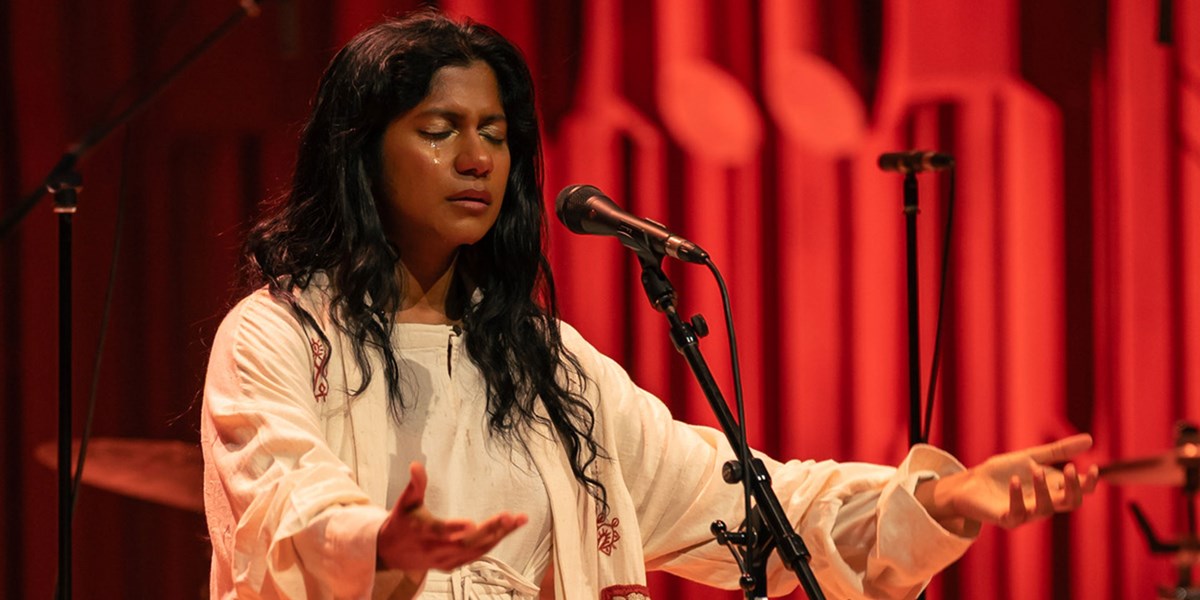
ganavya (photo courtesy of the Barbican)

Ganavya Doraiswamy, AKA ganavya, was born in New York, raised in Tamil Nadu and is now a resident back in the US. She has been incredibly busy recently, releasing three albums since 2024: Like the Sky I’ve Been Too Quiet, Daughter of a Temple and Nilam (a TOTW in Songlines #210). It’s her intensely spiritual voice and performance style that make her stand out. On stage at the Barbican, wearing a loose-fitting white robe, she began a quiet reading of ‘A Love Chant’ sans accompaniment. A couple of phrases in, she shifts to full voice, her unusually configured group of double bass, two harps and piano gradually joining her.
As this opener died away, I was surprised to hear what I assumed was the audience singing along in unison. But it quickly became apparent that it was ganavya’s Love Supreme Choir, emerging from the audience. Daughter of a Temple – from which much of the set was taken – pays tribute to American harpist-pianist-bandleader Alice Coltrane, hence the emphasis on harps, and a version of ‘Love Supreme’ [written by John Coltrane, and performed by Alice Coltrane in 1971] that was performed as the evening’s penultimate number.
This was ganavya’s biggest headline show to date, and she used the opportunity to invite along several guests, a different musician joining her for each song. These included saxophonist Immanuel Wilkins, singer-guitarist Sam Amidon, three other singers, her percussionist brother and her parents for an extremely long bhajan. Unfortunately, these cameos resulted in a performance both diluted and disjointed, with the involvement of her family even coming over as self-indulgent. It was also hard to hear the softly spoken introductions, which didn’t help the evening’s flow.
But there were still some standout moments, such as ‘Pasayadan’, from Nilam, one of a few solo songs sung in a deep chiaroscuro voice with simple piano, rather than the over-busy arpeggios pianist Jay Verma added elsewhere. ganavya appeared as if officiating at a ritual, urging her audience to participate, orchestrating them with bold gestures. She spoke movingly about her grandmother, also a singer, who raised her in India. After a hard life, ganavya said she “died a happy, curious musician”, confessing she hoped for a similar fate.