Thursday, September 18, 2025
Ustad Noor Bakhsh at The Rose Hill, Brighton, (August 26)
The benju virtuoso makes Daniel Spicer feel particularly superlative
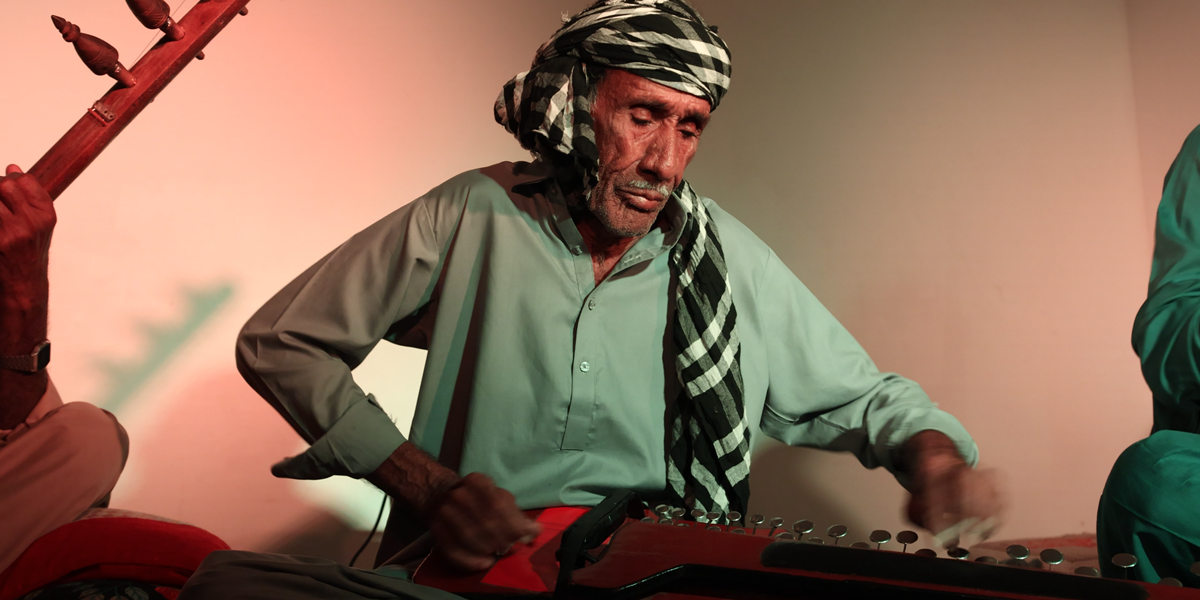
Ustad Noor Bakhsh at The Rose Hill (photo by JFU)

If I were a less cliché-averse critic, then I might call Ustad Noor Bakhsh the ‘Jimi Hendrix’ of the electric benju, especially when the sprightly octogenarian untangles himself from a cross-legged position, leaps to his feet and begins playing the instrument behind his head with a grin creasing his face and a twinkle in his eyes.
It’s not even the most extraordinary thing about him. Until recently, Noor Bakhsh was well-known only in the south of Balochistan – an arid, mountainous region that spans parts of Iran, Afghanistan and Pakistan. That changed in 2022, when he was tracked down and recorded by Karachi-based musician and ethnomusicologist, Daniyal Ahmed, resulting in his debut album, Jingul. Since then, Noor Bakhsh has played across Europe and the US, filling prestigious venues like the Barbican and Queen Elizabeth Hall. To see him playing in the intimate setting of Brighton’s cosy arts hub, The Rose Hill, is a rare treat.
It also provides an opportunity to study his astonishing virtuosity on the benju. Originally a Japanese toy called the taishōkoto, it’s a kind of zither (similar to the Indian bulbul tarang) fitted with typewriter-like keys, which was adopted by Balochi musicians and refined into a folk instrument. Noor Bakhsh uses a pick in his right hand to rapidly strike the strings, while using his left to press the keys, unleashing rapid runs and soaring solos. His benju is amplified, too, played through the same small amp he’s been using for 20 years. In his home village of Sindhi Paso – where there is no electricity – he powers it with a motorcycle battery. Here, in The Rose Hill, it cuts through the air with a stinging power.

Noor Bakhsh is flanked by the dashingly handsome Daniyal Ahmed to his left (also serving as the maestro’s interpreter for between-tune announcements) and, to his right, the taciturn Doshambay. Both are playing the damburag – a traditional Balochi long-necked lute related to the Indian tanpura – which is strummed vigorously providing both a sympathetic drone and a rhythmic base for Noor Bakhsh’s extemporisations.
The 90-minute set begins in a meditative mood but quickly picks up pace as Noor Bakhsh calls each tune, feeling and fuelling the energy in the room and deciding the setlist on the fly. As the vibe intensifies, he zooms through strident Balochi folk tunes and even a couple of Bollywood themes. His blazing, intricate runs seem to embody a primal, pan-global music, with tantalising echoes of Irish and Appalachian folk emerging. At one poignant moment, Ahmed announces that Noor Bakhsh wishes to play an original composition dedicated to his late son – a piece he rarely performs in public, but which feels right tonight. But primarily, this is a party. Noor Bakhsh’s blissful shredding electrifies the room, bringing the audience to their feet in joyous dancing. When he stands and flings his axe behind his head for a second time, an amazed Ahmed confides that the Ustad never usually does it twice in the same night. He’s enjoying himself. It’s truly a blessing.